
An Evening MENA Brief
Announcement + Weekly Brief | Jan 12, 2026
Happy New Year.
MenaTrack is back on Substack, and starting this week some readers will begin receiving the newsletter here.
A lot is happening across the Middle East and North Africa. The news is constant, but clarity is harder to find. Context gets lost as events move quickly.
MenaTrack focuses on slowing things down and making sense of what matters. Weekly emails will feature concise, country-level briefs. When major developments unfold, special editions will take a deeper look at the strategic implications.
If this is useful, welcome back. If not, you’ll find the unsubscribe link at the bottom of the email.
MenaTrack Brief
Iran: Protests Reach a Breaking Point; First-of-its-Kind Starlink Jamming
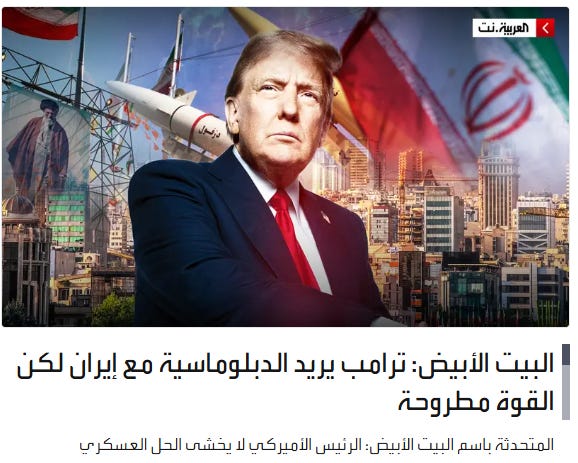
The headline from Al Arabiya (the Saudi-owned news outlet):
“The White House: Trump wants diplomacy with Iran, but force is on the table”
The anti-government protests that ignited in late December 2025 have intensified into a nationwide crisis following a historic collapse of the Iranian Rial, which hit 1.4 million to $1 last week. The regime has shifted to a “deterrence through fear” policy, labeling protesters as “terrorists” and implementing a total internet and telephone blackout to mask the deployment of IRGC Ground Forces. With over 200 deaths reported and thousands arrested, the unrest is now the most severe threat to Tehran’s stability since the 1979 Revolution.
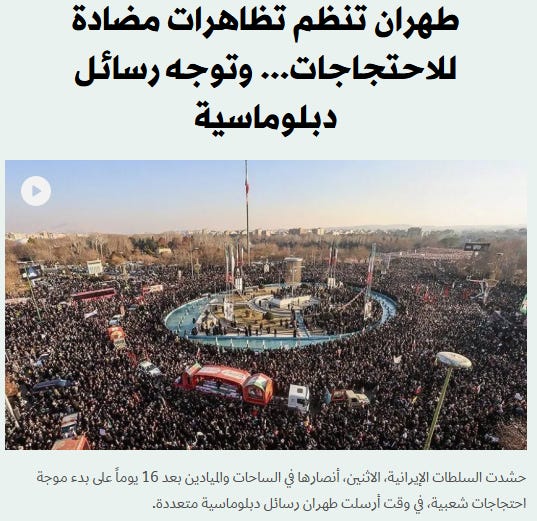
Tehran hosts pro-regime demonstrations following protests. The original headline reads: “Tehran organizes counter-protests… and sends diplomatic messages.” Image from Asharq Al-Awsat.

In a surprising turn of events, Iran has reportedly become the first nation to successfully deploy military-grade jamming to neutralize Starlink satellite internet on a broad scale. This first-of-its-kind move marks a significant evolution in electronic warfare, as the regime has successfully used sophisticated hardware-based interference to drown out signals previously considered resilient to state censorship.
“This is a first. What we’re seeing is not just GPS jamming, but possibly military-grade signal disruption designed to target even low-earth orbit satellites like those used by Starlink.” — Amir Rashidi, Digital Security Expert at the Miaan Group
Yemen: The Saudi-UAE Partnership Collapses
The long-standing alliance in Yemen has effectively fractured as Saudi-backed forces and UAE-aligned groups engage in a direct struggle for control of the south. Following a decisive Saudi-supported counter-offensive, the Southern Transitional Council (STC) was forced to cede control of Aden on January 10, with its leadership reportedly fleeing to Abu Dhabi. While the UAE maintains it is committed to the broader anti-Houthi coalition, the dissolution of the STC’s political assembly marks a significant shift toward a Saudi-dominated security architecture in southern Yemen.
Syria and Israel: Secret Diplomacy in Paris
Following the 2024 collapse of the Assad regime, Syria’s interim leadership and Israel have entered an unprecedented phase of U.S.-mediated coordination. During high-level talks in Paris on January 6, both nations agreed to a “joint fusion mechanism” for intelligence sharing to prevent accidental clashes near the Golan Heights. This de-escalation is critical as Damascus remains focused on intensifying battles with Turkish-backed militias near Aleppo and securing its northern borders amidst a massive internal displacement crisis.
Gaza and the West Bank: A Fragile Transition
A U.S.-brokered peace plan is currently facing a dual test of political transition and humanitarian survival. In Gaza, Hamas has signaled it will dissolve its government in favor of an international technocratic committee, yet the region faces a winter catastrophe as Israel moves to revoke the licenses of 37 international NGOs. In the West Bank, record-high settler violence and expanding security measures have drawn sharp international condemnation, even as the “Board of Peace” monitors begin the first phase of an international stabilization force.
Somalia and UAE: The Great Diplomatic Rupture
The Somali government officially annulled all bilateral agreements with the United Arab Emirates on January 12, 2026, terminating years of military and economic cooperation. This decision ends Emirati management of strategic ports in Berbera, Bosaso, and Kismayo following allegations of “hostile actions” against Somali sovereignty. Mogadishu specifically cited unauthorized airspace breaches to transport Yemen’s STC leadership and the UAE’s suspected role in Israel’s recognition of Somaliland as primary catalysts for the break. This sudden diplomatic rift creates a dangerous security vacuum for the federal government at a time when al-Shabaab maintains a heavy presence around the capital.
Saudi Arabia and Pakistan: The “Debt-for-Defense” Deal
Riyadh and Islamabad are operationalizing a landmark security pact that converts $2 billion in Saudi loans into a procurement package for JF-17 Thunder Block III fighter jets. This “debt-for-defense” swap allows Pakistan to gain critical financial breathing room while giving Saudi Arabia a diversified defense supply chain independent of Western oversight. The deal signals the birth of a new military axis in the region, with reports suggesting Turkey may soon join this trilateral defense arrangement.
Sudan: 1,000 Days of War and Partition Risks
January 9, 2026, marked 1,000 days since the civil war began, leaving Sudan with the world’s largest displacement crisis. De facto governments have emerged in Darfur (RSF) and the North (SAF), leading to fears of a permanent partition similar to the North-South split of 2011. With 37% of health facilities non-functional and famine confirmed in Al Fasher, the international community is warning of a total collapse of the Sudanese state.
Lebanon: Weapons Control South of the Litani
In a rare move to assert state authority, the Lebanese Army announced on January 8 that it has completed the “first phase” of its plan to confine all weapons to state control south of the Litani River. While Hezbollah has historically resisted disarmament, the government is leveraging a 2024 ceasefire to deploy thousands of troops into former militia strongholds. The success of this transition is seen as the “litmus test” for Lebanon’s ability to avoid being pulled back into a broader regional war.
Egypt: EU Strategic Security Pivot
Cairo and Brussels have officially elevated their relationship to a “Comprehensive Strategic Partnership.” On January 10, Egypt and the EU announced they will launch their first-ever Joint Security and Defense Dialogue in March 2026. This pivot comes as the EU provides Egypt with €5 billion in loans to stabilize its economy, in exchange for Cairo taking a leading role in maritime security in the Red Sea and managing migration flows.